I love road trips. Always have. My family was a road tripping family. We logged thousands of miles together, and one of the small pleasures was looking back at the route afterward. Tracing the line on the map. Remembering why we cut south here, why we doubled back there. Oh right, that diner was closed, so we went up to the next town. The route always made sense in retrospect, even the detours.
It occurred to me recently that I have never done this with my life. I have looked back at where I have been, of course, but I have rarely asked the harder question: who put this map together? The presumption, like on a road trip, is that I chose the route. The older I get, the less sure I am that is true for many of us.
Most of us, once a destination is determined, hit the road at 100mph, leaving the map in the hands of our navigator. We busy ourselves negotiating the traffic of life. We are managing the immediate. The next exit. The car ahead of us braking. The kids in the back seat. The gas gauge dropping faster than expected. We do not have the bandwidth to also be reading the map, so we rely on a navigator in the passenger seat. Parents. Grandparents. Pastors. Mentors. Friends. People who love us, who we trust, who we believe have our best interest at heart. We hand them the map and we keep our eyes on the road, and we trust that when they say turn here, this is the way, the destination they are guiding us toward is the one we actually want to reach.
Most of us never stop to have that conversation. Not with them and not with ourselves. We are too busy navigating the traffic of life to ask. And often we only find out, after we have arrived and lived there a while, that the destination was never ours. It was theirs. It was where they would have gone, or where they wished they had gone, or where the world told them people like us were supposed to end up.
In 2001, a realtor told my wife and me that we should buy one rental property for each of our children. We were young. We were seeking counsel (e.g. directions to a financial destination someone had told us we must reach). The advice was given in good faith, I have no doubt of that, by a woman who probably said the same thing to a dozen other couples that year. It came off the cuff. It was, in the technical sense, a sales conversation.
We took it home and made it sacred.
Here is what I see now that I could not see then. Two different handoffs happened in those early years, and I missed both of them.
The first was the destination. Somewhere along the way, before that realtor ever walked into my life, I had absorbed the idea that a good parent, a good provider, a good steward, builds something tangible for his children to inherit. That was the place I was headed. I did not chose it consciously. It was handed to me by the culture I grew up in, by the men I admired, by a vision of fatherhood I had never questioned. I did not investigate where the destination came from. I just knew I was supposed to arrive there.
The second handoff was the route. Once I accepted a destination without examining it, I found myself in a particular kind of bind. I knew where I was supposed to go, but I had no idea how to get there. That void is unbearable, so I reached for the first navigator who seemed to know the way. For me, that was a realtor with a confident voice and a piece of advice that fit neatly into the space my anxiety had opened up. One property per child. There it was. A route.
This is how most of us end up where we are. We do not pick our destinations and we do not pick our routes. We inherit the first, then grab at the second, and call the whole thing a life well planned.
For 25 years, that one sentence shaped my marriage, my economics, and the way I loved my children. Stewardship became the shape that love took, the way I proved I cared by what I was building for them. By the time I looked up, one of the most defining vows of my adult life had come from a woman whose job was to sell me a house.
This is not a story about real estate. It is a story about how easily love attaches itself to a frame, a destination, a route, that was never ours to begin with, and how rarely we go back and check the authorship. We all do this. We accept a piece of advice in a vulnerable moment, from a person we trusted enough to listen to, and we walk out of the room carrying it as if it were ours. Then we spend decades building a life around it without ever asking where or who it came from.
And once you see one of those, you start seeing them everywhere. The realtor who sold you stewardship as virtue. The pastor who sold you grace as something earned. The self-help industry that sold you promises to a future self, masquerading as goals, never to be broken, always to be achieved. None of these institutions are villains. Most of the people doing the selling believed what they were saying and had good intentions, and we have to remember we asked for their input to begin with. It becomes the air a person breathes growing up in a particular family, a particular faith, a particular profession, and then we mistake it for who we are.
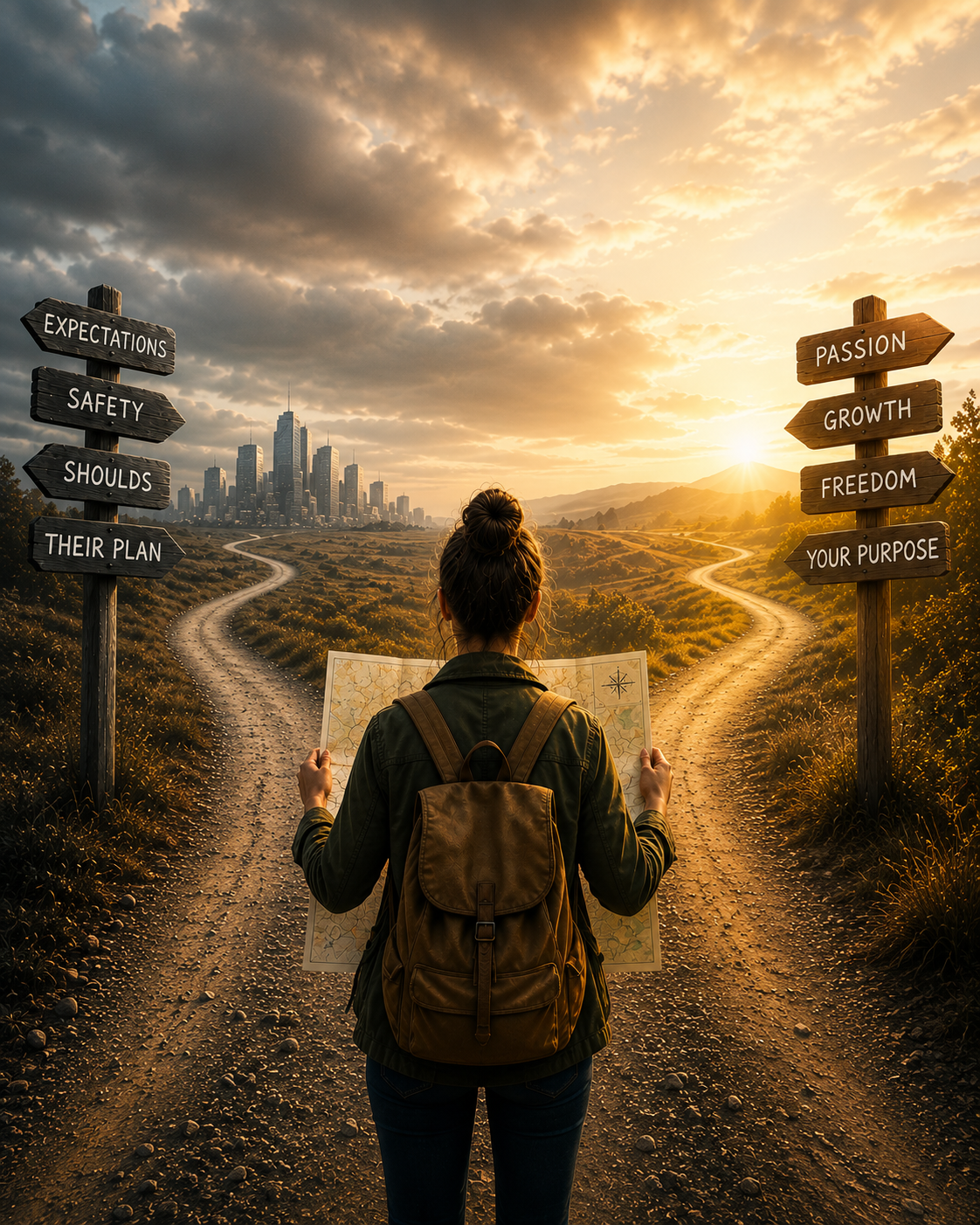
When I look at the map of my adult life, I see a lot of destinations and roads written in someone else's hand. Most of those directions begin with two small words: "you should...". Then we "should" ourselves down roads we never chose, and defend those routes as if we had laid them out.
Destinations come in many forms. What profession we should choose. Where we should live. Who we should marry. But the biggest danger comes when one of these destinations becomes a covenant, a sacred story we tell ourselves about where we are supposed to end up. Covenants are destinations we chase without ever knowing if there is a route, and often we plow ahead down dark empty highways with no navigator at all, determined to get there. Someone hands us the name of the place, or an idea like one property per child, partner at the firm by 40, the marriage that never ends in divorce, and we commit to arriving. What they do not tell us is what is between us and the destination. They do not mention the Grand Canyon we will have to cross to get there, or the years of horrible weather, or the cost of the gas. By the time we find out, we are already a thousand miles in, and we have told everyone we know where we are headed.
That is when the second trap closes. The further down the road we go, the more turning around feels like the failure. Not missing the destination itself, the turning around. The body knows what it cost to get this far. The body resists undoing it. There is a visceral resistance, physical, not metaphorical, when we try to move against a thing we have already declared. We will pour more money into a property that should be sold. We will stay in a job that is hollowing us out. We will refuse to speak to people we love. Not because the destination still makes sense, but because the miles already driven feel too expensive to waste.
Other inherited destinations can be revised mid-trip without much trouble. Covenants cannot, because we have built our identity around the arrival. To turn the car around is to admit the version of us who set out did not know what the trip would actually cost. Most people would rather drive off the cliff.
The realtor's suggestion became a covenant of that kind. A blind pursuit of a destination I was given but felt I had chosen. To be honest, there were plenty of signs along the way that warned of trouble ahead, but I was moving at breakneck speeds in tight traffic with no ability and no desire to read them carefully. Eventually, I made it. I surpassed it, even.
Now, sitting here a quarter century later, my wife gone, my children estranged, the thought of selling one of those properties does not feel like a financial decision. In the absence of those relationships, the properties are one of the last places they still live. Letting one go does not feel like selling real estate. It feels like cutting off a piece of me.
I am beginning to understand that in the audit of a life, we may discover destinations and routes that were never ours. That discovery does not undo the journey we took to arrive where we are today. This is not a moment to wipe the map clean or to believe that backing up to the last turn and starting over is the way forward. The lines already drawn on the map are not shame and failure that need erasing. They are what build the legend. They show us where the cliffs are, where the bridges were out, where the storms caught us, where the road washed away. The next stretch is safer because we have driven the last one.
Here is the beauty of it. We do not have to start over in the jalopy we set out in. If we take a good inventory, that jalopy has become something closer to a Bentley with the improvements we made along our journey. We may not be at the destination we would have chosen yet, but the trip from here can be made in comfort. A destination we choose. A route we plan. A copilot we know and love, who agrees that no matter how bad the traffic, no matter how fast the pace, there will be moments to pull over and evaluate where we are headed and how we are getting there, and to make adjustments where they are needed.
The question is no longer am I following the directions I was given. The question is who is in the car. What do I actually want. Where is God actually leading. Which of these sacred things will I keep because they are mine, and which will I set down at the next rest stop because I was only ever carrying them for someone else.
I do not know yet where this road goes. I suspect that is the point. I have spent my whole life trying to create purpose out of inherited directions. What I am being asked to do now is harder and slower and quieter. Discover, do not create. Pull the car over. Look at the trees. Trust that the way out of the forest reveals itself to people who stop long enough to see it.
Performance theology says I earn the blessing through faithfulness, and I have to keep earning it, or lose it. Grace says it was never mine to earn and never mine to lose. Every life eventually offers a test of which one is actually believed.
The map I was handed got me here. I am grateful for the people who drew it. And I am beginning to understand that the next stretch of road is not on it, and was never going to be.
That is the project. Not just mine. Anyone's, who is willing to ask whose map they have been following, and brave enough to draw the next stretch themselves.
Lost, with everywhere to go.
— J. Michael Weems