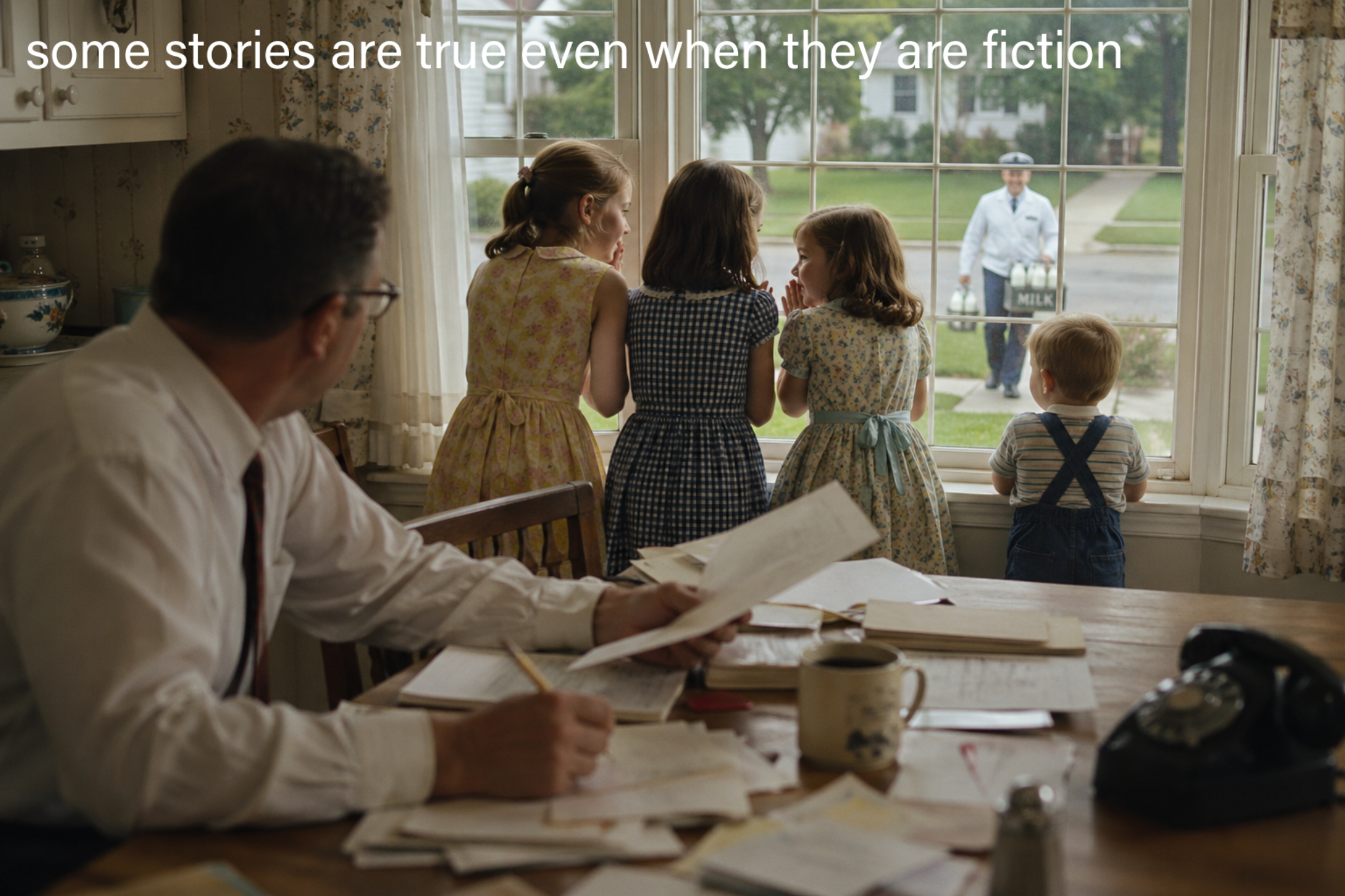
Morning light spilled through the bay window where four children crouched, their breath fogging the glass. They weren’t just watching; they were guarding the house like soldiers at a fort.
“There he is,” Margaret whispered, her eyes narrowing on the white truck easing down the street. At twelve, she carried herself like a commander. “The Milkman. Don’t be fooled—he’s not what he seems.”
Her brother Thomas, hesitated. “But… maybe he’s just delivering milk?”
Margaret cut him off. “That’s what he wants you to think. That smile, those bottles—they’re just a cover. He’s working with the Mailman. Together, they’re going to overthrow the whole neighborhood.”
Lucy and Charlotte, the two middle girls, looked uncertain. Lucy fiddled with her braid. “He looks nice to me.”
“Nice is the first step to dangerous,” Margaret snapped. Her eyes glittered with certainty. “That’s how they hide in plain sight—by looking ordinary. Even the way his hair is parted looks suspicious, too neat, like he practiced it in the mirror just to trick us. Don’t you get it? Nothing is what it seems. Now take your weapons.”
She passed them out—wooden spoons, cardboard tubes, and a cracked water gun. Reluctantly, Charlotte and Lucy obeyed. Thomas, the youngest, seemed caught between excitement and fear, his knuckles white around his spoon.
He admired Margaret, their fearless commander, and longed for her approval. Yet beneath the thrill of battle, a knot of doubt tugged at him. Something didn’t feel right. Still, terrified of losing his sister’s love, he tightened his fist around his weapon and fell in line.
In the kitchen behind them, their father hunched over a heap of bills. His back ached from another twelve-hour shift. He worked himself raw, day after day, carrying a family who never seemed to notice. But the children, wrapped in their fantasy, never saw him there.
The truck stopped. The Milkman hopped out, whistling a tune as plain as morning toast. He carried his crate up the walk, the glass clinking cheerfully.
“Positions!” Margaret ordered.
The doorbell rang—a harmless chime, yet in their ears, it was the bugle of war. The door swung open, and four small voices exploded.
“Bang! Pow!” “Enemy down!”
The Milkman gasped, clutching his chest, and staggered back with a masterful groan. He dropped to one knee, his smile fading as he fought to draw one last breath. With trembling hands, he pulled a small carton from his bag and held it aloft like an offering.
“This is for you…” he whispered, voice breaking. “Your favorite ice cream… .”
For a moment, the words lingered in the doorway, heavy and out of place in their imagined war. Then the carton slipped from his fingers as he collapsed onto the porch, his words hanging in the air like a benediction no one asked for.
Thomas froze, spoon trembling in his hands. His lip quivered, and suddenly tears spilled down his cheeks. “We… we killed him,” he sobbed, clutching Lucy’s sleeve. “We really killed him.”
Lucy’s face crumpled too, but before she could speak, Margaret’s voice sliced through the air. “Don’t cry for him,” she said firmly, her chin jutting forward. “He was evil. He deserved it.”
The younger ones fell silent, their tears checked by the authority of their sister’s certainty.
From the kitchen, their father looked up. He had caught every word—the Milkman’s dying gift, his son’s tears, his daughter’s cold dismissal. His eyes lingered on the scene at the door. His heart ached. He knew, better than anyone, how it felt to offer ice cream and for it to be received as poison.